01
Long-neck fern gardener
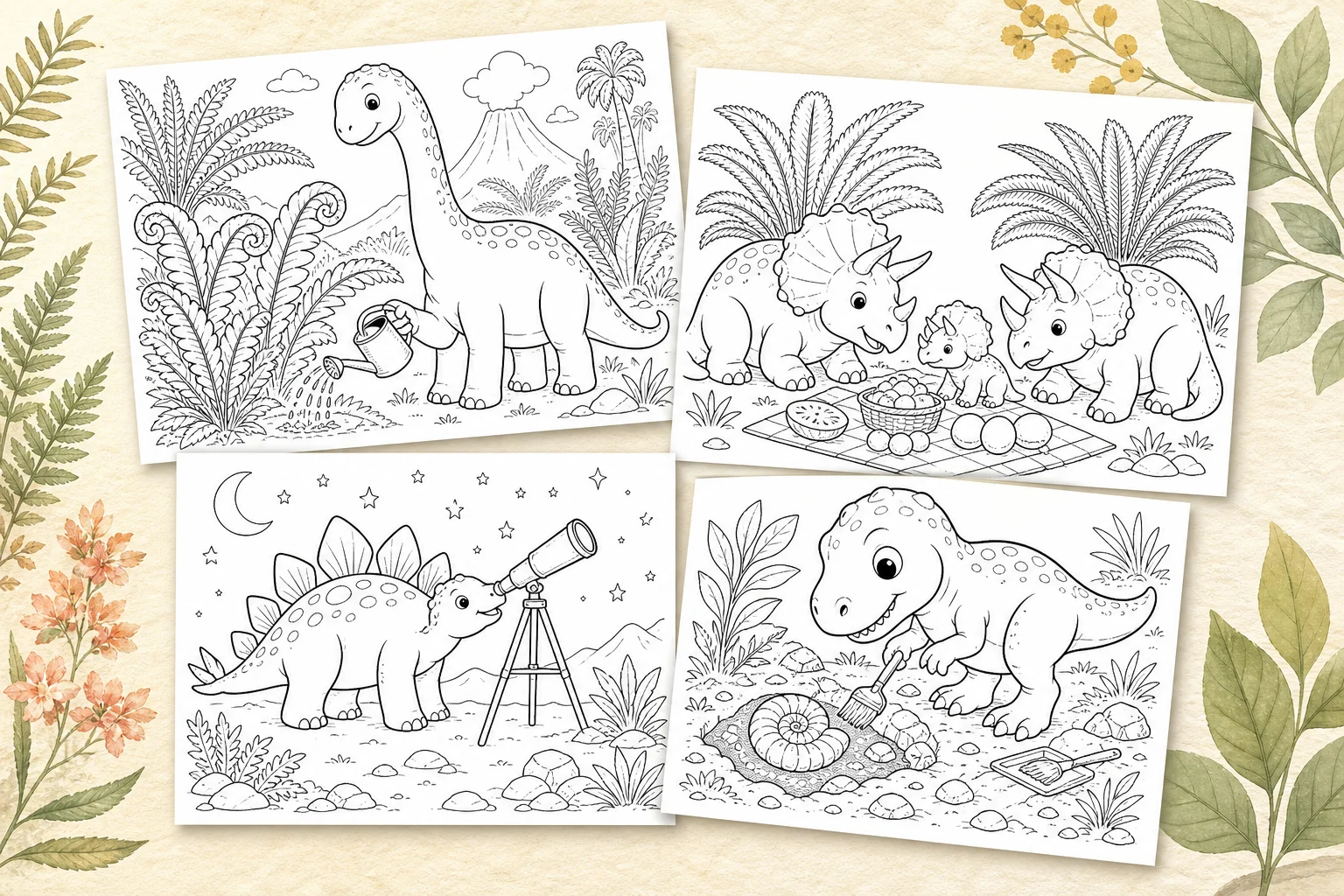
A gentle long-neck dinosaur watering broad prehistoric ferns beside three smooth stepping stones.
Original prehistoric coloring ideas
A good dinosaur coloring page begins with one recognizable dinosaur and one clear action. These twelve original scenes use real dinosaur types, broad coloring spaces, and imaginative settings without copying movie, television, toy, or game characters.
Choose the little story first
The clearest pages do not begin with a crowded prehistoric world. Start with a silhouette people can recognize—a long neck, three horns, back plates, or powerful tail—then add one action and only the plants, tools, or scenery needed to explain it.
A gentle long-neck dinosaur watering broad prehistoric ferns beside three smooth stepping stones.
Two adult triceratops and one little one sharing fruit on a blanket near broad cycads.
A small stegosaurus looking through a simple telescope beneath a crescent moon and large stars.
A young tyrannosaurus brushing soil from a spiral fossil beside a tray and hand lens.
A broad dotted trail of three-toed footprints winds between two ferns and a small nest.
An ankylosaurus carrying fallen fruit in a low basket beneath three broad-leaved trees.
Three parasaurolophus friends playing a drum, shakers, and broad leaf chimes.
A parent hadrosaur watching over three large eggs between reeds and rounded rocks.
A friendly brachiosaurus recording a distant gently smoking volcano from a hilltop shelter.
A small plate-backed dinosaur crossing broad river stones with fish and reeds below.
Two young dinosaurs tending giant leaves, seed trays, hanging vines, and a watering can.
A curious dinosaur reading beside a fossil display, sleeping bag, lantern, and star window.
Before you make it
Detail is not a quality score. It changes the size of the coloring spaces and how much story the setting carries.
Keep the dinosaur large, separate its head, legs, and tail clearly, and use only a few broad supporting shapes.
Add one task and two or three props, while protecting open spaces around the face and limbs.
Use foreground and background details, but keep foliage away from the dinosaur silhouette and avoid tiny repetitive scales.
A real creation path
Lumo does not treat the subject as a one-click filter. The caregiver chooses the activity and visual density before deciding whether the page is ready for paper.
Create with Lumo — free to start“A gentle long-neck dinosaur watering giant ferns in a quiet prehistoric garden.”
Choose Coloring for broad open areas, or Story when you want to reuse the gardener in another scene.
Start with medium line weight, normal detail, and a simple background so the silhouette stays clear.
Review the anatomy and coloring spaces, refine if needed, then open the native print sheet.
Useful boundaries
No. The collection uses generic dinosaur types and original scenes. It intentionally avoids character names, costumes, logos, signature props, and visual identities from entertainment properties.
A large long-neck, triceratops, stegosaurus, or hadrosaur silhouette works well. Keep one animal centered, use broad outlines, and remove most background detail.
Yes. Use a footprint route or one large simple silhouette, choose Tracing, and keep the path spacing generous instead of adapting a densely detailed coloring scene.
This is an original idea collection rather than a bulk PDF library. Choose a scene, then make a personalized printable in Lumo, which is free to start.